


Common House Gecko – The Unseen House Guest that is Everywhere!
Looking up at your ceiling on a humid night, you might spot a quick flash of movement or hear a soft chirp from the wall. The culprit? Most likely, the Common House Gecko. This tiny reptile, often dismissed as a household pest, is a marvel of adaptability and resilience. This humble survivor has not just thrived in close quarters with people but has managed to take over neighborhoods, cities, and entire continents!
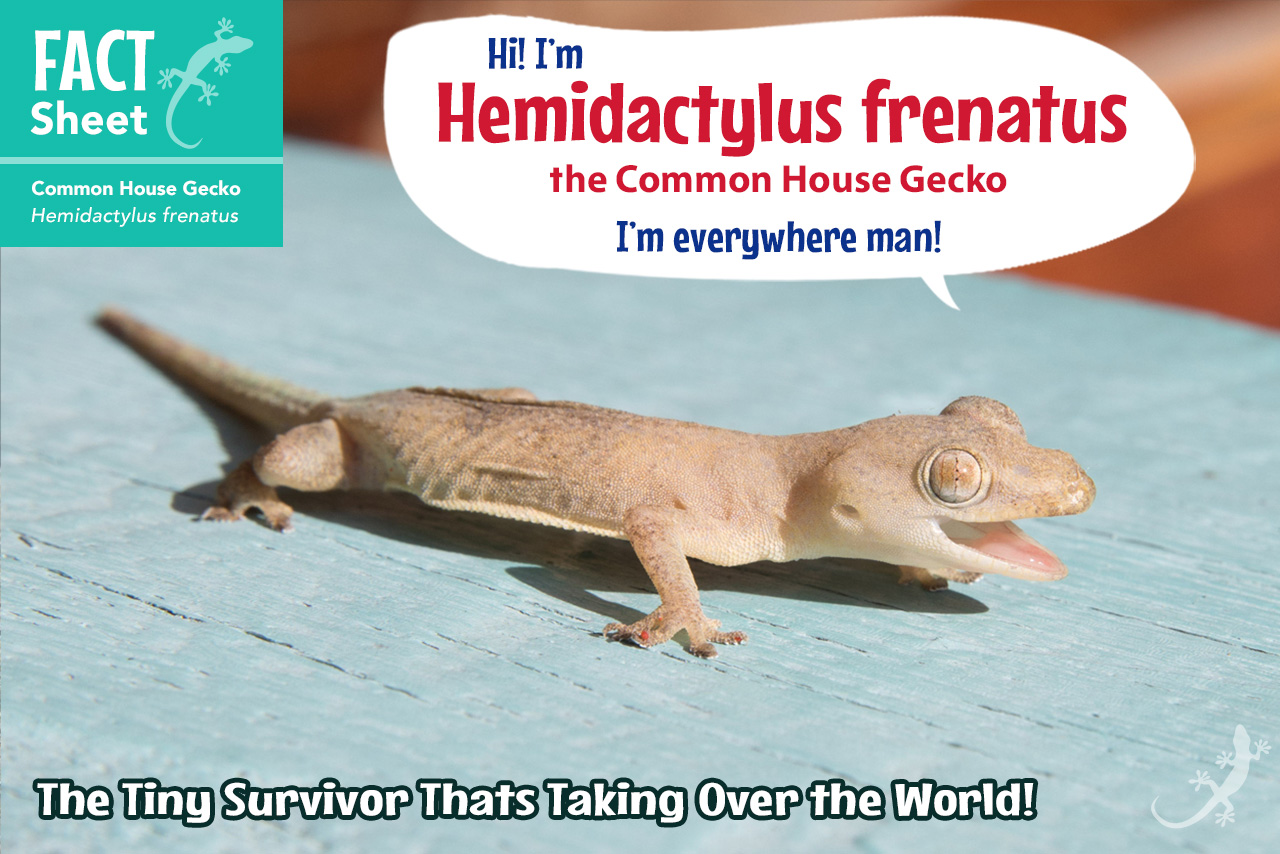
Whether you’re a curious pet owner, a reptile enthusiast, or a biology student, there’s more to this gecko than meets the eye. Read on for all the particulars about the understated, but abundant Common House Gecko.







Table of Contents
- Meet the Urban Survivor &World-Class Adaptability
- Taxonomy & Classification
- Native Habitat & Global Distribution
- Physical Characteristics
- Behavior & Ecology
- Reproduction
- Common House Geckos in Captivity
- Conservation Status
- Fun Fact Corner
- What the Common House Gecko Can Teach Us
Meet the Urban Survivor &World-Class Adaptability
The Common House Gecko is the ultimate opportunist. With its world-class adaptability, this small reptile has found a way to coexist (and often thrive) in almost any environment altered by humans. While it happily scurries across wild landscapes and forest edges, it’s just as at home scaling plaster walls, hiding behind picture frames, or even stowing away on ships.
Some even keep them as low-maintenance pets, drawn to their hardy nature and insect-eating prowess. The Common House Gecko proves that survival, sometimes, comes in the form of speed, stealth, and a willingness to live wherever life takes you, and being a master of making the best of any situation.
Taxonomy & Classification
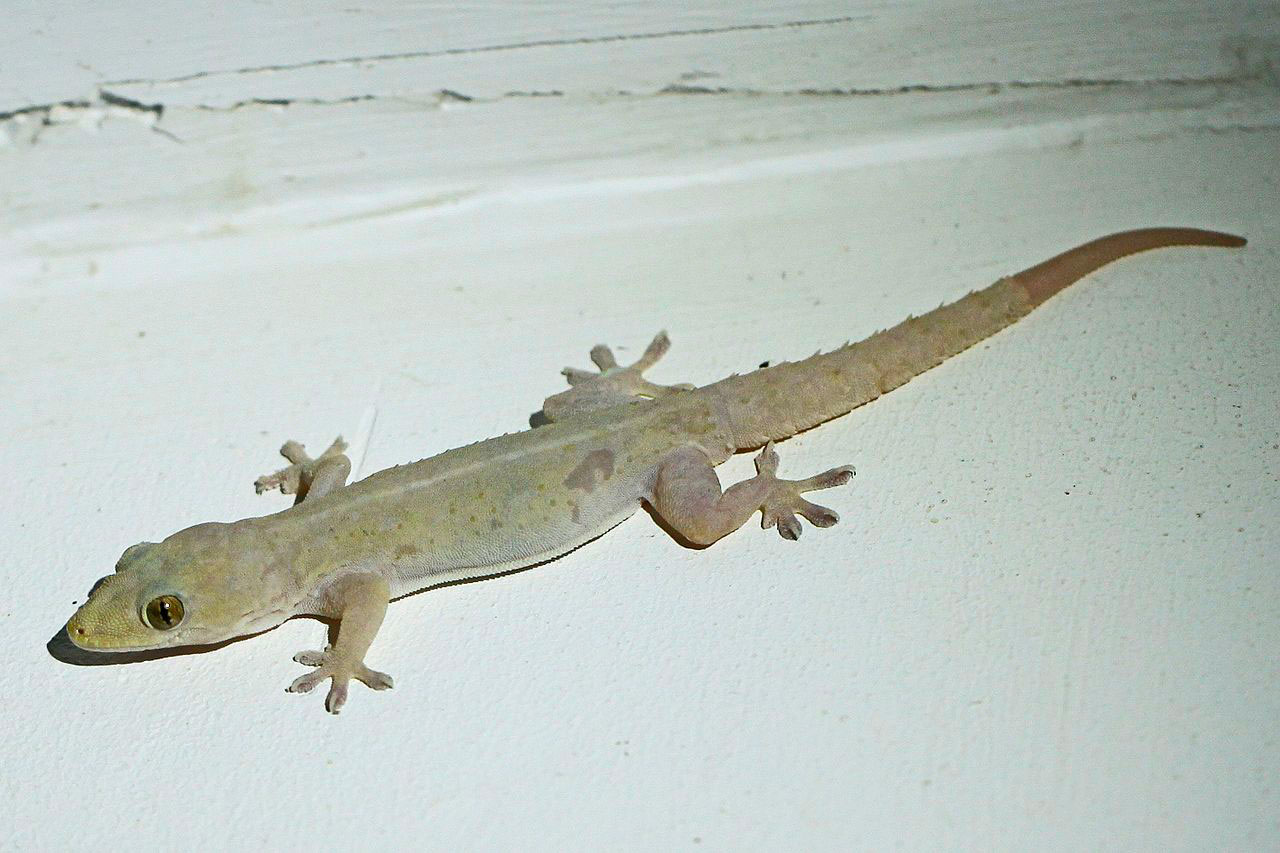
Curious about where the Common House Gecko fits in the grand scheme of animal life? Here’s how scientists classify this tenacious reptile:
- Kingdom: Animalia
- Phylum: Chordata
- Class: Reptilia
- Order: Squamata
- Family: Gekkonidae
- Genus: Hemidactylus
- Species: Hemidactylus frenatus
But did You Know?
While Gekkonidae is the largest and most famous gecko family (most of the common geckos you know — house geckos, tokay geckos — are from here), not all Geckos are from the Family of Gekkonidae! There are a total of 7 Families to which geckos are classified under:
| Family | Notes |
|---|---|
| Eublepharidae | The “eyelid geckos” — includes leopard geckos! They have movable eyelids (rare for geckos). |
| Sphaerodactylidae | Tiny geckos, including some of the world’s smallest reptiles. (Like the dwarf gecko Sphaerodactylus ariasae.) |
| Phyllodactylidae | Leaf-toed geckos — adapted toes that look like little leaves. |
| Carphodactylidae | Weird, mostly Australian geckos like the knob-tailed geckos (Nephrurus). |
| Diplodactylidae | Mostly in Australia and New Zealand. Includes Rhacodactylus (like crested geckos before they were moved to Correlophus). |
| Pygopodidae | “Legless geckos” — they look like snakes but are actually geckos! Found in Australia. |
The genus Hemidactylus is one of the most species-rich gecko groups, with many cousins to the Common House Gecko, each showing off unique evolutionary twists.
Native Habitat & Global Distribution
Common House Gecko proves that survival, sometimes, comes in the form of speed, stealth, and a willingness to live wherever life takes you, and being a master of making the best of any situation.
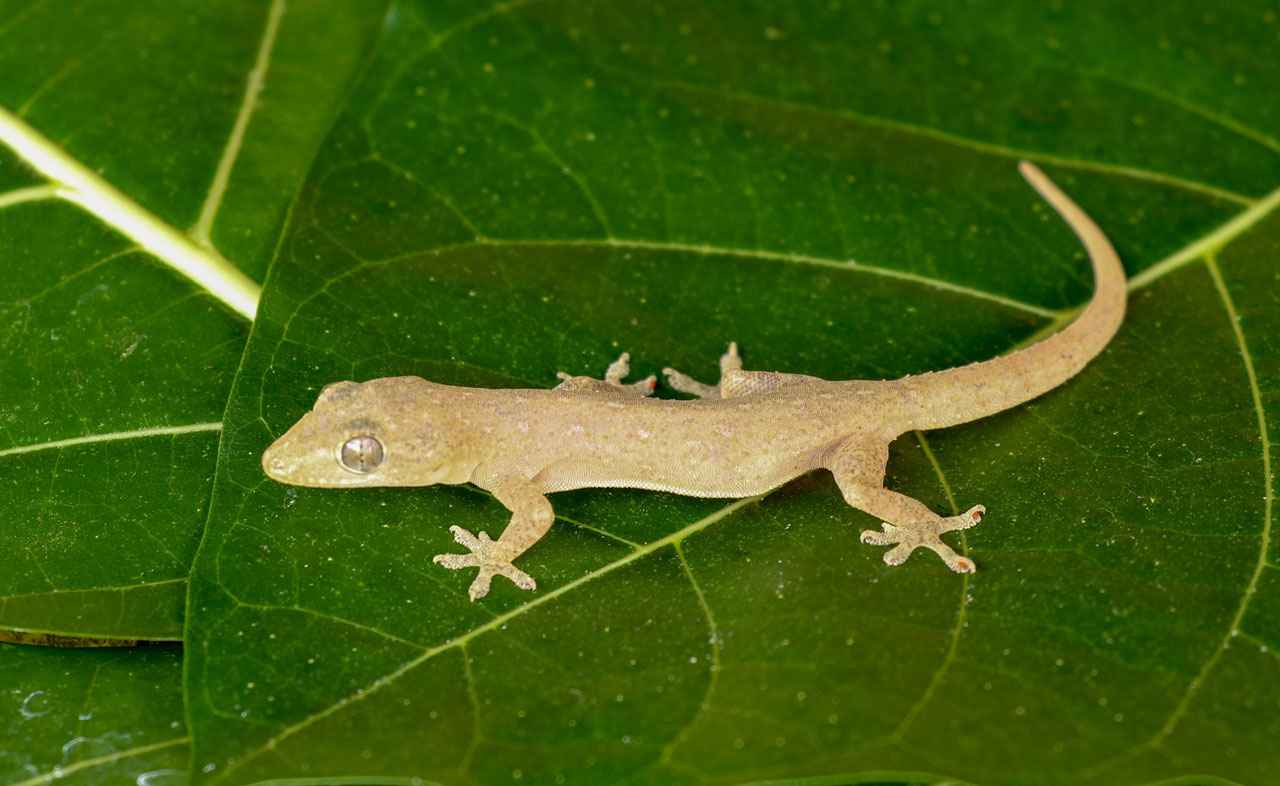
- Thrives in Diverse Landscapes: These geckos are equally comfortable in crowded cities, quiet rural villages, and untouched forests.
- Hitchhikers of the Modern Age: House geckos have colonized new lands by stowing away with human trade and travel. Shipping containers, plant pots, luggage, and even military gear have spread them far from their Southeast Asian origins.
- Reproductive Power: Rapid reproduction and the ability to adjust to varied climates underpin this species’ widespread success.
- Native Home: Southeast Asia, with Malaysia and Indonesia as likely birthplaces.
- Now Global: Thanks to human movement and adaptability, they are now found across Asia, Africa, Australia, the Americas, and many Pacific islands.
- Human Neighbors: They usually seek shelter near people, appearing on walls, ceilings, gardens, and even venturing aboard ships.
- Nocturnal Activity: Most active at night, Common House Geckos take advantage of artificial lights, which attract their insect prey.
If you’ve seen a small, ghostly lizard catching moths under a porch lamp, you’ve likely encountered the Common House Gecko.
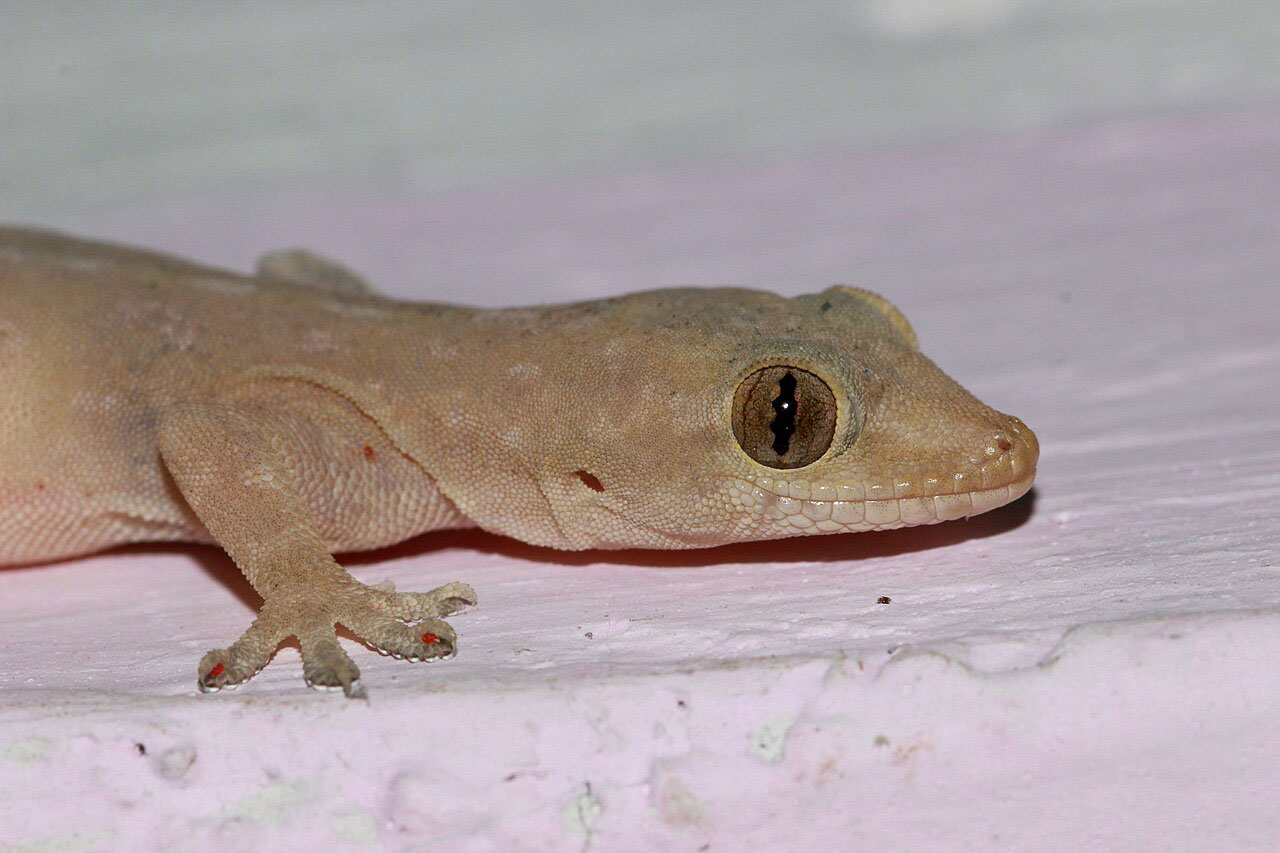
Physical Characteristics
Despite their modest appearance, Common House Geckos have evolved a design that puts form firmly in the service of function.
- Size: Adults typically reach 3–6 inches in total length and weigh between 4–8 grams.
- Coloration: Their skin ranges from translucent to pale grayish-tan, often speckled with faint spots or stripes, helping them blend in with walls and stone.
- Super Sticky Toes: Tiny hair-like structures (setae) on their toe pads allow these geckos to defy gravity, climbing smooth vertical surfaces, glass, and even ceilings.
- Tail Autotomy: Their tails are fragile and easily shed when threatened, giving them a chance to escape predators.
While they may not be as flashy as their Leopard or Crested kin, Common House Geckos are textbook examples of evolutionary efficiency.
Behavior & Ecology
The Common House Gecko’s behaviors are as resourceful as its living arrangements:
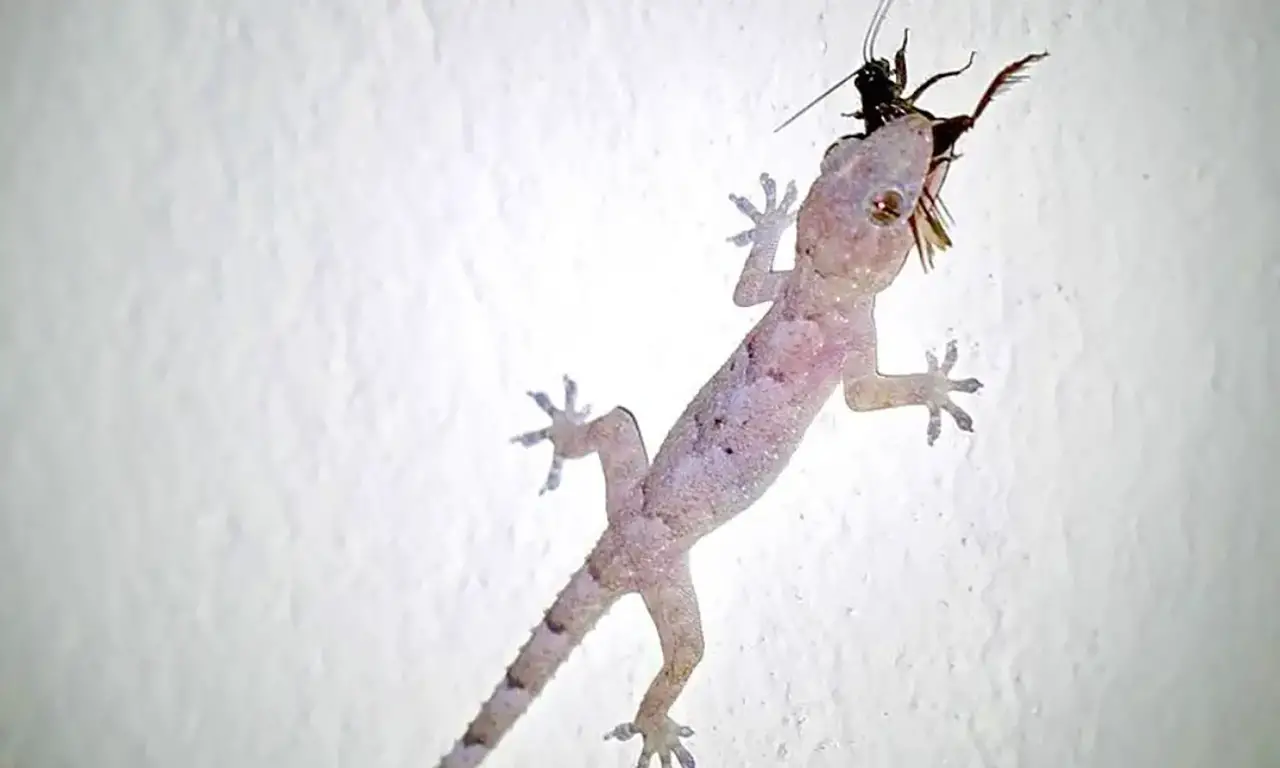
- Diet: Nocturnal and insectivorous, these geckos devour moths, flies, roaches, spiders, and other small arthropods.
- Territorial Instincts: Males are known for defending their territory aggressively, often against other geckos.
- Communicative Calls: Males use a series of chirping sounds, similar to bird calls, to ward off rivals or entice potential mates.
- Use of Human Structures: Artificial lighting creates perfect hunting grounds, as moths and mosquitoes gather around lamps.
Their presence in the home is often welcome, given their appetite for pests, but they’re rarely seen during the day.
Reproduction
Breeding is where the Common House Gecko’s success story shines.
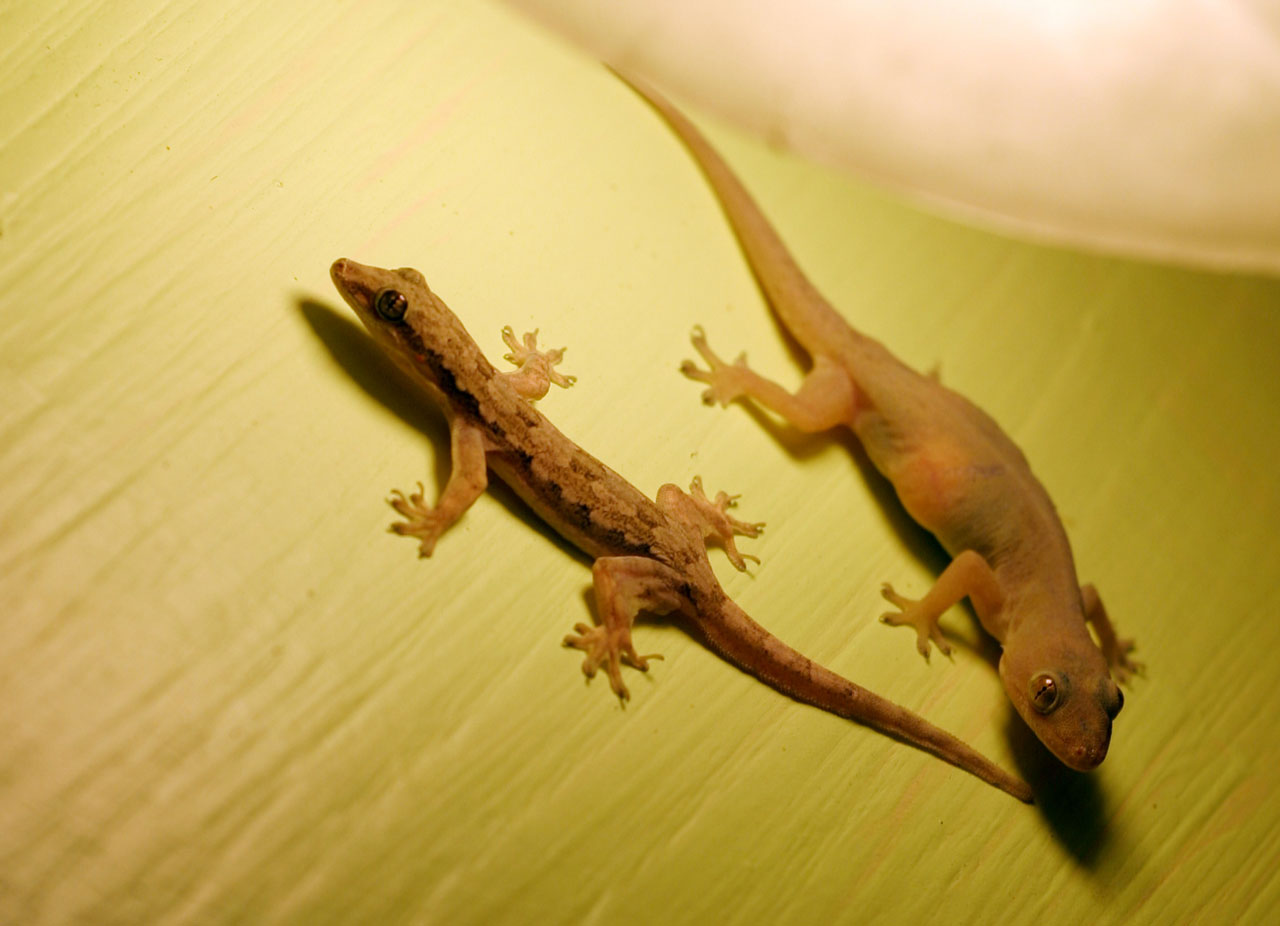
- Breeding Habits: Year-round fertility in tropical climates means populations can grow rapidly.
- Egg Laying: Females usually lay two small, hard-shelled eggs per clutch, gluing them to hidden surfaces like walls, under bark, or in cracks.
- Fast Independence: Hatchlings emerge fully independent, ready to hunt from the start.
This reproductive efficiency, combined with adaptability, helps house geckos quickly establish new populations wherever they find a warm home. For more about the reproduction of the House Gecko and more see the video below:
Common House Geckos in Captivity
While not as popular as some other pet geckos, H. frenatus makes an interesting, if somewhat challenging, companion.
- Hardy Survivors: They thrive in captivity with minimal fuss. Provide them with warm temperatures, small live insects, and vertical climbing space.
- Not for Handling: These geckos are fast, skittish, and fragile. Handling should be avoided to prevent injury, especially tail drops.
- Lifespan: With proper care, captive house geckos can live 5–10 years.
They’re ideal for those interested in observing natural behaviors, rather than those seeking a handleable reptilian friend.
Conservation Status
No need for worry here:
- Not Endangered: The species is thriving globally and is often considered invasive outside its native range.
- Competition: Their presence in new territories can threaten native geckos and small reptiles, sometimes pushing out local species.
Their adaptability is both their strength and, in some ecosystems, a challenge for other wildlife.
Fun Fact Corner
A few extra reasons to appreciate the Common House Gecko:
- Upside-Down Running: Thanks to microscopic hair-like setae, geckos can run upside-down on ceilings and glass windows, performing aerial acrobatics that would make Spider-Man jealous.
- Extraordinary Eyesight: Their vision at night is around 350 times more sensitive than human eyes, making them exceptional nocturnal hunters.
- Cultural Significance: Across parts of Asia, finding a gecko in your house is thought to bring luck and ward off evil.
What the Common House Gecko Can Teach Us
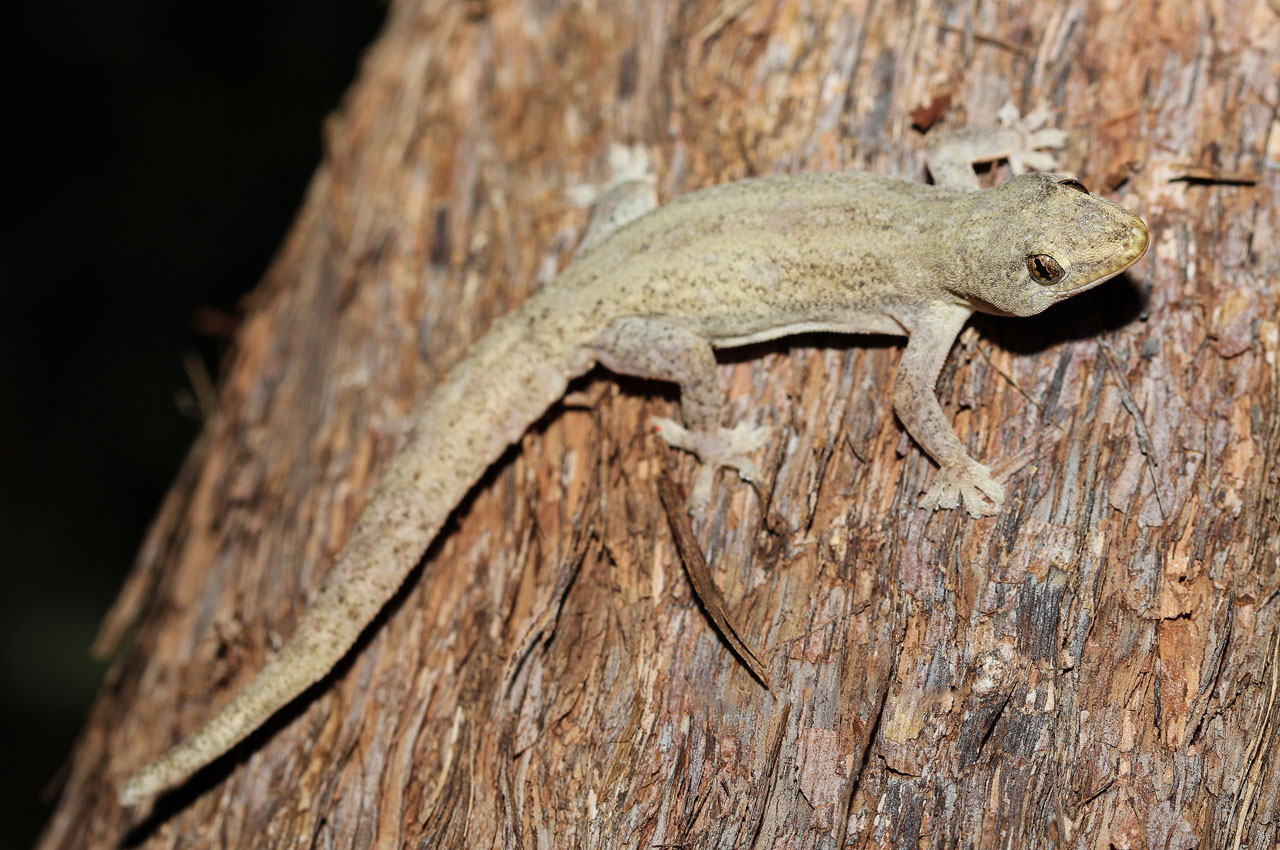
While not colorful or rare, the Common House Gecko is a master class in survival and adaptability. Its quiet presence in our homes, gardens, and cities is a living example of how some creatures ride the waves of human expansion to global prominence. Whether you spot one hunting by your porch light or consider keeping one as a pet, the Common House Gecko is a fascinating study in successful animal coexistence.
Curious to learn more or thinking about adding a tiny survivor to your reptile family? Explore reputable care guides or reach out to herpetology communities for advice. And the next time you hear a gentle chirp or spot a fast-moving shadow on the wall, remember you’re in the company of one of the animal kingdom’s most persistent little conquerors.